About this project
This project was authored by Joe Abbate, Gerry Angelatos, and Akshay Krishna for the Princeton University graduate course APC524 (fall 2018).
All of the code, along with a link to the readthedocs site, is available at https://github.com/jabbate7/PhotonicNeuronSimulator.
Documentation is generated via Sphinx.
In addition to the pip packages specified in requirements.txt, you must install ffmpeg to create animations.
Testing
Unit tests are automatically run by Travis each time new code is pushed,
and the readme automatically displays whether the tests
are passing or failing. The unit tests are written in test.py
and include basic and complex cases for both neurons and networks.
Profiling
We used the cProfile utility to profile our neural network solver. Our benchmarking was done for a 4-input 16-neuron network with random weights and delays. Our input was a time series of length 20000.
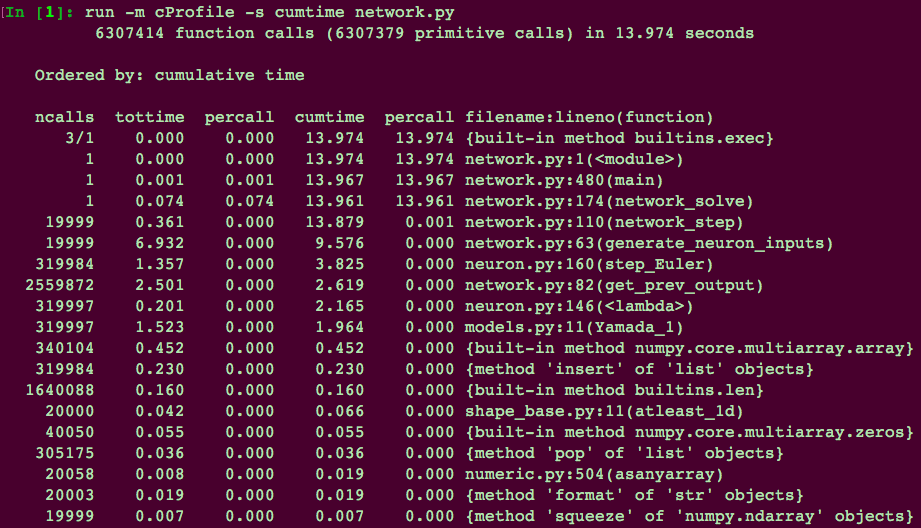
Profiling results
The entire simulation takes about 14 seconds to run. Each of the
network_step() and generate_neuron_inputs() functions is called
19999 times (the number of time steps necesary to move through the time series).
The most time consuming step was in the generate_neuron_inputs() function.
This function calculates the sum of all weighted and delayed inputs to each neuron in the network. By necessity, it must loop over all nonzero neurons on the network, and iterate over all entries in the adjacency matrix of connections. Further algorithmic optimization is not possible, to the authors’ knowledge.